You wake up already behind. Unread emails are waiting, your workout never happened, a friend's message still needs an answer, and the side project you care about is stuck halfway through. None of these tasks is impossible on its own, but together they make every aspect of my life feel like a separate emergency.
The usual response is to create more lists, download more apps, and add more reminders. That can make the day look organized while leaving your attention even more scattered. A better approach starts by seeing your life as a connected system, choosing one area to improve, and using a calm daily checkpoint to notice whether your actions match the person you want to become.
Table of Contents
- Why Every Aspect of My Life Feels Like Too Much
- What an Aspect of Life Really Means
- The Four Core Areas Worth Tracking
- Choosing Tools That Match Each Area
- Connecting the Areas with One Weekly Rhythm
- Common Traps That Block Real Change
- Your First 30 Days of Focused Progress
Why Every Aspect of My Life Feels Like Too Much
On a Tuesday morning, you reply to a work message while thinking about poor sleep, remember a promised call to a family member, and notice a personal goal that has sat untouched for weeks. By breakfast, your health, relationships, career, and personal growth are all asking for attention from the same limited supply.
That pressure can make every area look like a failure. Yet several parts of life may be functioning reasonably well. The heavier problem is often the number of unfinished concerns competing in your mind at once.
The hidden cost of separate checklists
Separate tracking systems can add to the noise. A fitness app records movement, a calendar stores social plans, a task manager holds work deadlines, and a notes app contains reflections. Each tool can serve its purpose, but you still have to remember how the pieces affect one another.
Consider what happens after a poor night's sleep. You move less, become less patient in a conversation, rush an important email, and skip the course or reading habit that usually keeps you engaged. The day appears to contain four unrelated problems. A connected view reveals one weak foundation passing strain through the rest of the system.
Practical rule: Zoom out before you zoom in. Look across your life first, then decide which area deserves deliberate attention this week.
A connected view does not require constant measurement. One calm, local-first habit app can act as a daily checkpoint: record a brief check-in, notice a small win, and mark the friction that needs attention. Because the checkpoint is in one place, it can connect the four areas without adding another stream of notifications.
That connection also keeps improvement manageable. You might actively work on sleep this week while preserving simple habits for relationships, career, and growth. A small change in one area can make the others easier to maintain, much like repairing a loose hinge before forcing a door open.
A more useful question for this week is: which aspect of my life needs a little support now, and what small action would make the rest easier?
What an Aspect of Life Really Means
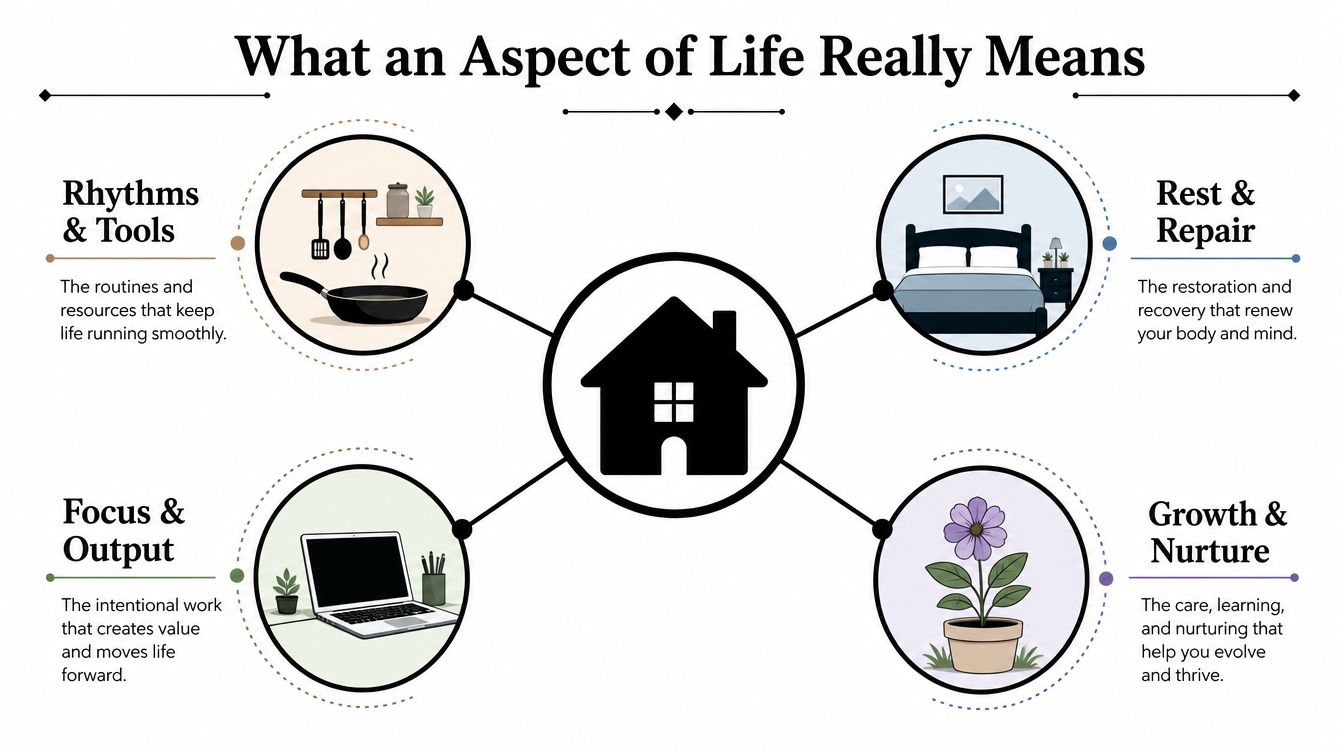
An aspect of life is a broad area that shows where your energy, attention, care, and time go. Your life works like one house with several rooms. The kitchen supports nourishment and daily rhythms, the bedroom supports rest, the workspace supports contribution, and the garden represents learning and growth.
Each room has different maintenance needs. A leaking tap calls for a repair in the kitchen, while a crowded bedroom may need a calmer evening routine. Yet every room shares the same structure. If meals become chaotic, your energy may fall. If rest is neglected, focused work can feel harder the next morning.
Name the room before changing it
Vague goals rarely guide an ordinary day. “Get healthier” sounds useful, but it leaves several possible actions: go to bed earlier, take a walk, drink water, or make a medical appointment. Naming the area turns a broad wish into a question you can answer.
Try this process:
- List the major rooms. Start with health, relationships, career, and growth.
- Describe the current rhythm. Record what you already do, rather than what you hope to do.
- Choose a visible behavior. Pick an action you can check without debate.
- Give it an identity. Replace “complete a task” with “I'm someone who protects focused work.”
- Review without judgment. Treat missed actions as information about how the design needs to change.
A lightweight tracker can support this process without turning life into a dashboard. It might record a walk, a call, a focused session, or a reading habit. The aim is a clear window into each room, not a camera watching every moment.
The four areas work best as connected rooms in one home. Naming each area makes its links visible, helps you choose a priority, and keeps improvement aligned with the life you live.
The Four Core Areas Worth Tracking
The four areas are broad enough to cover daily life but specific enough to guide action. Each one needs different signals. A health habit shouldn't be judged like a career milestone, and a relationship can't be reduced to a completion percentage.
| Life Area | Sample Habits to Track | Real Progress Looks Like |
|---|---|---|
| Health | Sleep routine, daily movement, hydration, energy check-in | More reliable care for your body and clearer awareness of energy |
| Relationships | Check-in with someone close, shared meal, repair conversation | More intentional contact and earlier attention to friction |
| Career | Focused work block, learning session, follow-up, pipeline action | Consistent progress on meaningful work, not just a busy calendar |
| Growth | Reading, journaling, language practice, creative skill work | Regular curiosity and practice that expand your capabilities |
Health is more than a number
Health tracking works best when it captures behaviors and signals you can influence. You might log whether you followed a bedtime routine, moved during the day, drank enough water for your needs, or noticed low energy.
The purpose isn't to turn your body into a performance report. A brief entry such as “slept poorly, short walk, energy low” can explain why concentration or patience felt different later.
A 2024 systematic review and meta-analysis of health-related habit formation examined 20 studies involving 2,601 participants. It found median habit-formation times ranging from 59 to 66 days, mean times from 106 to 154 days, and individual experiences ranging from 4 to 335 days. The review concluded that most health behaviors generally need about 2 to 5 months before becoming automatic, so a missed day shouldn't be treated as proof that a routine has failed.
Relationships need presence, not volume
Relationship habits can be small and personal. A weekly call, a shared meal without a screen, or a message asking a real question may matter more than maintaining constant contact. You can also track repair, such as returning to a tense conversation instead of allowing resentment to settle.
The useful signal is intentionality. A check-in asks, “Did I give this relationship care?” It doesn't attempt to score another person or turn affection into a productivity target.
Career progress happens below the title
Career tracking should capture actions that create future options. A focused work block, a thoughtful follow-up, a portfolio improvement, or time spent learning can be more informative than a job title or an overflowing task list.
Growth deserves room of its own. Reading, journaling, practicing a language, drawing, or studying a technical skill may not produce an immediate external reward, but these activities shape the person who can handle future opportunities.
The areas influence one another constantly. Poor sleep can make a difficult conversation feel sharper, a work email less careful, and a learning session easier to postpone. That connection is useful because it helps you solve causes rather than merely record symptoms.
For ideas on translating these categories into repeatable routines, explore habit tracker apps and related approaches.
Choosing Tools That Match Each Area
No tracking method wins for every purpose. A paper journal gives you space to think, but it may be inconvenient when you want to mark a habit quickly. A spreadsheet can organize patterns, but opening it for a tiny daily action may feel like administrative work. An all-in-one productivity suite can hold tasks, notes, goals, and calendars, yet its flexibility can become another decision to make.
The best tool is the one you'll open when the day is ordinary and your motivation is low. A system that looks impressive but feels heavy will eventually become a forgotten project.
| Tracking Style | Best For | Watch Out For |
|---|---|---|
| Paper journal | Reflection, emotional context, personal meaning | Entries can become inconsistent or difficult to review |
| Productivity suite | Career tasks, deadlines, projects, quarterly planning | Too many fields can make daily check-ins feel like work |
| Spreadsheet template | Comparing routines and reviewing patterns | Manual maintenance may create friction |
| Lightweight habit app | Repeated behaviors, streaks, reminders, quick check-ins | Simple logs may need separate space for deeper reflection |
Match the tool to the behavior
Health habits often need a simple confirmation. “Walked,” “followed sleep routine,” or “checked energy” can be enough. Relationships may benefit from calendar reminders and a short note about who you want to contact. Career goals usually need deadlines and project context, while growth habits often work better with reflection prompts or reading records.
Identity-based tracking adds another layer. Instead of logging only the action, you connect it to a self-description: “I'm someone who moves daily,” “I protect important relationships,” or “I practice skills that matter to me.” That framing can make a small behavior feel like evidence of direction rather than another box to tick.
A tool such as IdentityKit's goal-setting app approach fits the narrow space between a blank notebook and a complex productivity suite. Its documented features include identity-based habits, streak tracking, user-scheduled reminders, local-first storage, optional Apple Health access, and AI insights that run when requested. It should be treated as one possible fit, not a replacement for every planning tool.
Use a structured dashboard for larger outcomes, such as a project deadline or a quarterly learning target. Use a low-friction check-in for behaviors that need repetition. The two systems can coexist, provided they don't force you to enter the same information twice.
Connecting the Areas with One Weekly Rhythm
A weekly checkpoint turns four categories into one connected view. Reserve 30 minutes at a chosen time and use the same sequence for each area: give it a 1 to 5 rating, record one small win, name one point of friction, and select one action to carry into the coming week.
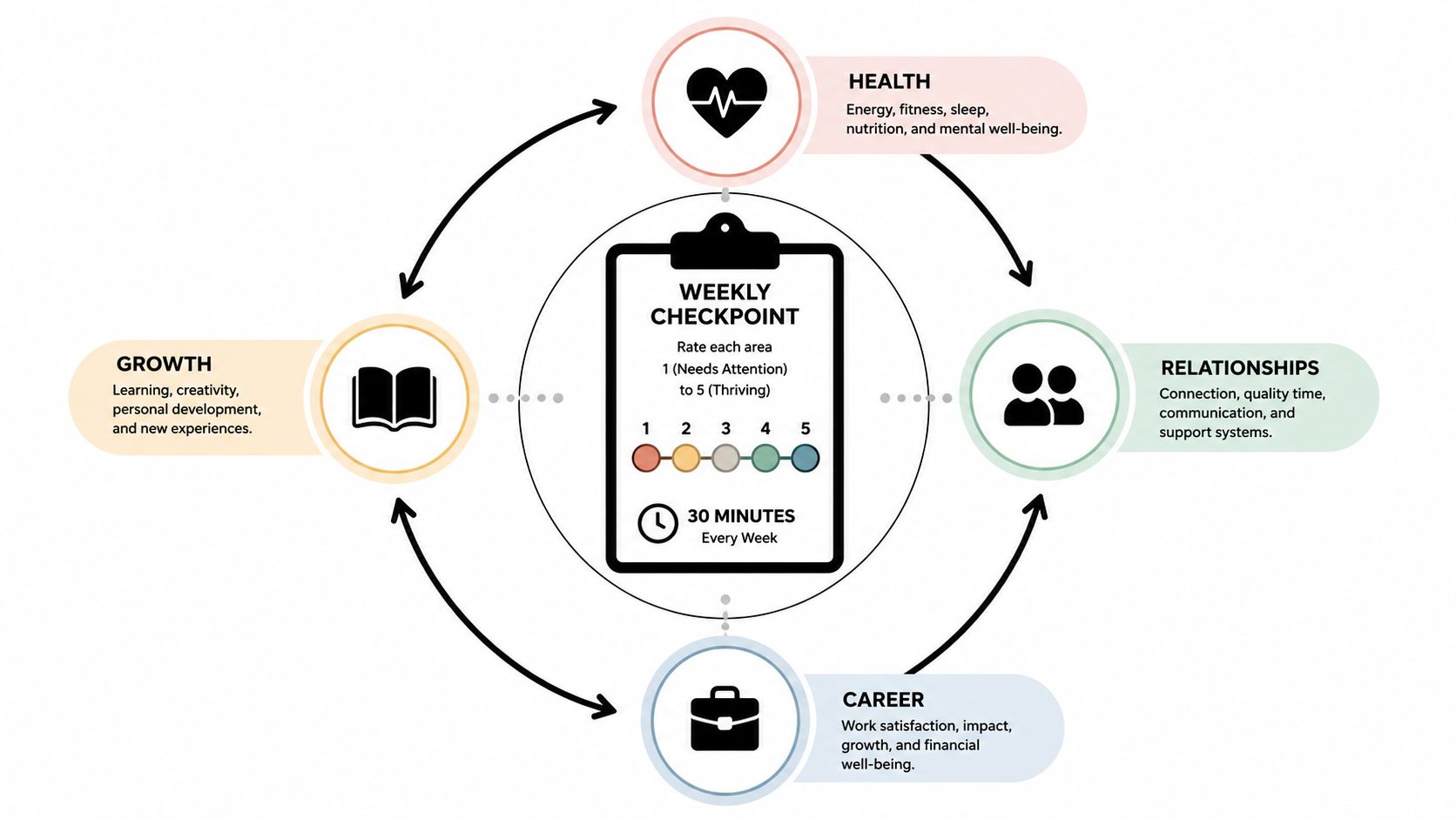
Treat the rating as a prompt for comparing your experience with your intention, not as a scientific measurement. A health score may reflect energy and recovery. A career score may show whether meaningful work received protected attention. Read the four ratings together, because a demanding project, poor sleep, and missed social contact can be parts of one pattern rather than separate problems.
Review the four areas
Begin with health. Note the action that supported you and the condition that made it harder. Review relationships next, including contact that felt nourishing and conversations that may need repair.
For career, ask whether an important project moved forward or whether incoming demands filled the day. For growth, record what you practiced or explored, even when the session was brief.
Use plain language:
- Health: “Energy was uneven. Evening walks helped.”
- Relationships: “Called my sister. Avoided one difficult conversation.”
- Career: “Completed focused work. Let meetings expand into the afternoon.”
- Growth: “Read consistently. Skipped language practice on late nights.”
Choose one action that supports more than one area. A walk with a friend can serve health and relationships. A protected morning block can support career and growth. Preparing for sleep may improve health while making patience and focus easier the next day. This connection keeps the review from becoming four isolated checklists.
Design the checkpoint around your attention
Set reminders for moments you have already chosen, such as after breakfast or before closing your laptop. A local-first habit app can hold the daily evidence and offer one weekly checkpoint, without turning every area into a separate stream of alerts. A streak counter can show continuity, while a summary remains available when you request it.
Research on medication adherence offers relevant evidence for these mechanisms. A 2020 meta-analysis of mobile applications for medication adherence pooled 1,785 patients and reported an overall effect size of Cohen's d = 0.40, with a 95% confidence interval of 0.27 to 0.52. The behavior differs, but prompts, self-monitoring, and review overlap with habit tracking.
Keep the rhythm yours. Software can display history or summarize patterns when asked, while you decide what deserves attention and which action connects the four areas.
Common Traps That Block Real Change
More tracking does not guarantee more progress. A useful system reduces decisions, protects attention, and makes returning after an imperfect day easier. The four areas should meet at one practical checkpoint, rather than becoming four competing streams.
Notification overload
Frequent prompts can make an app feel like another demanding person in the room. A randomized trial involving 150 adults in a 9-week mobile learning program found that algorithmically timed notifications produced higher daily adherence than self-scheduled reminders, 82% versus 67%. Consistency fell sharply after reminders stopped, while overly frequent alerts increased fatigue. These findings appear in the trial on notification timing and adherence.
The takeaway: schedule reminders at moments you have chosen, and keep each alert actionable rather than frequent. A local-first habit app can make one daily check-in visible without sending separate alerts for health, relationships, career, and growth.
Dashboard neglect
A polished dashboard can become a hobby instead of support. If you stop opening it, its categories and charts no longer help. Begin with the smallest view that answers two questions: “What did I do?” and “What needs care next?” A weekly review can then connect one action to more than one area, such as a walk that supports health and relationships.
Privacy as an afterthought
Your habits may reveal health concerns, moods, relationships, and vulnerabilities. Research on digital behavior-change interventions identifies privacy as a persistent challenge and calls for clear information about data handling in this review of privacy and trust issues.
Apple states that Health data is encrypted on locked devices and that third-party sharing requires explicit permission. Its Health app documentation explains that iPhone and connected devices can count steps and walking or running distance, while permissions can be managed or revoked in Settings.
Watch for warning signs:
- Duplicated logging: You enter the same habit in several places.
- Ignored streaks: The visual record no longer changes your behavior.
- Rising anxiety: Check-ins make you feel judged rather than supported.
- Unclear data boundaries: You cannot tell what stays local or leaves the device.
Your First 30 Days of Focused Progress
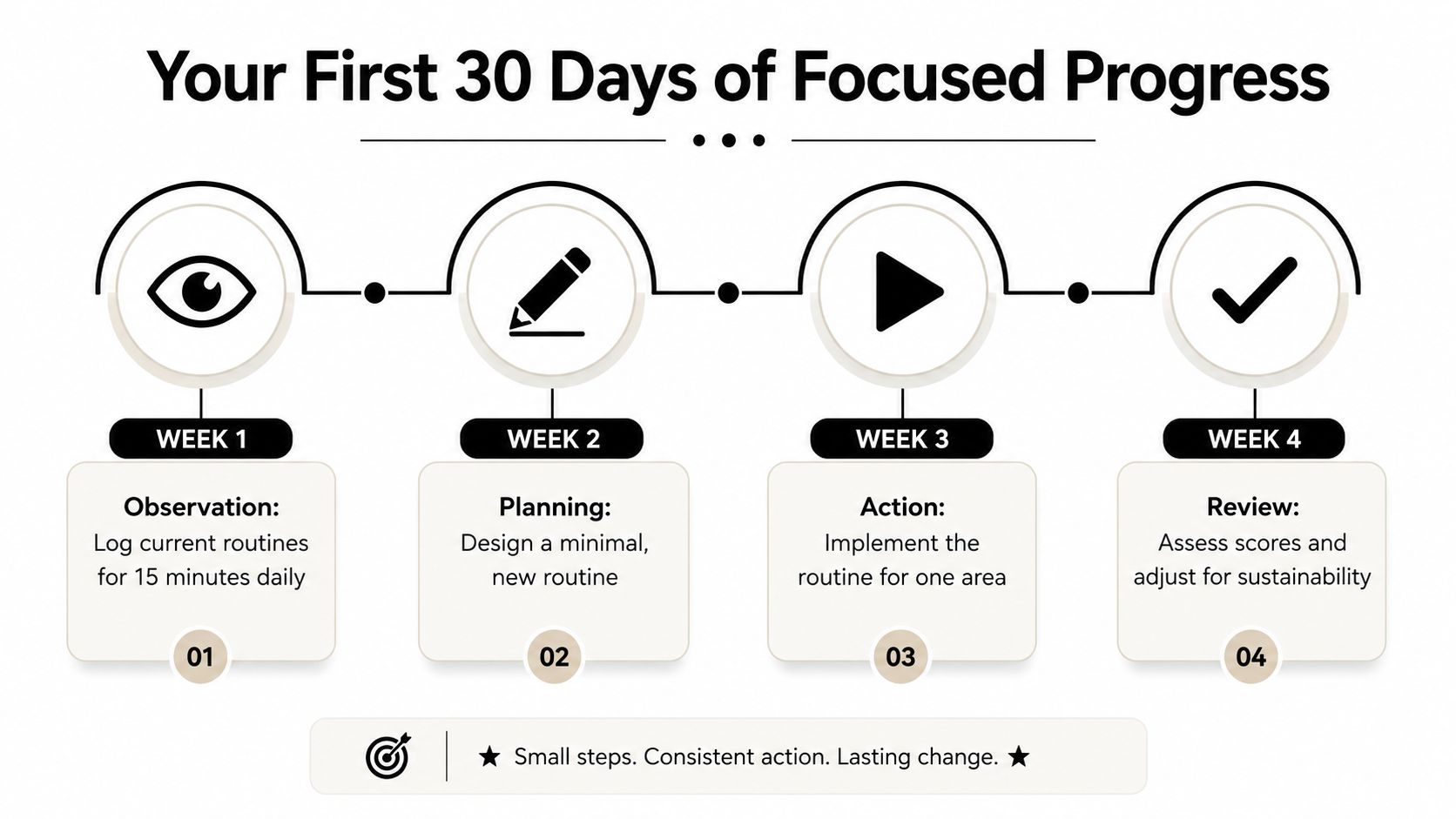
Choose one area first. Focusing on one area reduces the number of changes you manage at once, while the other three remain part of the same connected system and can benefit later.
Week 1 for observation
Pick health, relationships, career, or growth. For 15 minutes a day, record what you already do and where the routine catches. Do not change anything yet. If sleep needs attention, note when work ends, when you use your phone, and what makes bedtime late.
Observation keeps you from designing a routine for an imaginary life. Your schedule, energy, and obligations show what can fit.
Week 2 for identity
Add one anchor habit. Make it small enough to begin without negotiation, such as a 10-minute walk framed as, “I'm someone who moves daily,” rather than a calorie target. A relationship anchor could be one intentional message. A career anchor might be a protected focus block, and a growth anchor could be a short reading session.
The identity statement gives the action meaning. The action still has to fit an ordinary day.
Week 3 for a lightweight log
Record the anchor and one supporting cue each evening. Keep the check-in under a minute. Mark the walk and note whether placing your shoes by the door helped. The purpose is to learn which conditions make the habit easier, not to create a perfect record.
A free goal-setting app can support this routine by keeping the daily action visible without adding unnecessary steps. Used as a shared checkpoint, one local-first habit app can also show how a health action affects energy for work, connection, or learning, without separate notification noise for every area.
Week 4 for review
Look back at the month. Keep what fits your life, adjust what demands too much willpower, and remove anything that creates more pressure than value. Then schedule a weekly checkpoint linking the current area with the next one you want to support.
Use this rule: pick one aspect, run one habit, log one line, review one time. A routine that survives busy days will carry further than a perfect system abandoned when work becomes demanding.
Focused progress in one area can support the others because energy, clarity, and confidence travel with you. Start with the room needing the most care, then let the rest of the house benefit from the repair.
IdentityKit gives iPhone users a local-first place to track identity-based habits, streaks, user-scheduled reminders, and optional Apple Health-linked routines, with AI insights available only when requested. Visit IdentityKit to create a calmer daily checkpoint for the aspect of your life you're ready to strengthen.